The square feels alive in that particular European way where history isn’t something preserved behind glass—it’s performed, worn, and spun into motion right in front of you. In the foreground, a young couple turns in tight, practiced circles, their arms raised and linked in a posture that looks both formal and effortless, like muscle memory passed down through generations. The woman’s dress catches the moment beautifully: a deep green dirndl with a patterned skirt that flares outward mid-spin, its fabric lifting just enough to reveal the structure beneath. There’s a softness to it, but also a kind of precision—this isn’t costume for show, it’s clothing that knows exactly how it’s supposed to move.
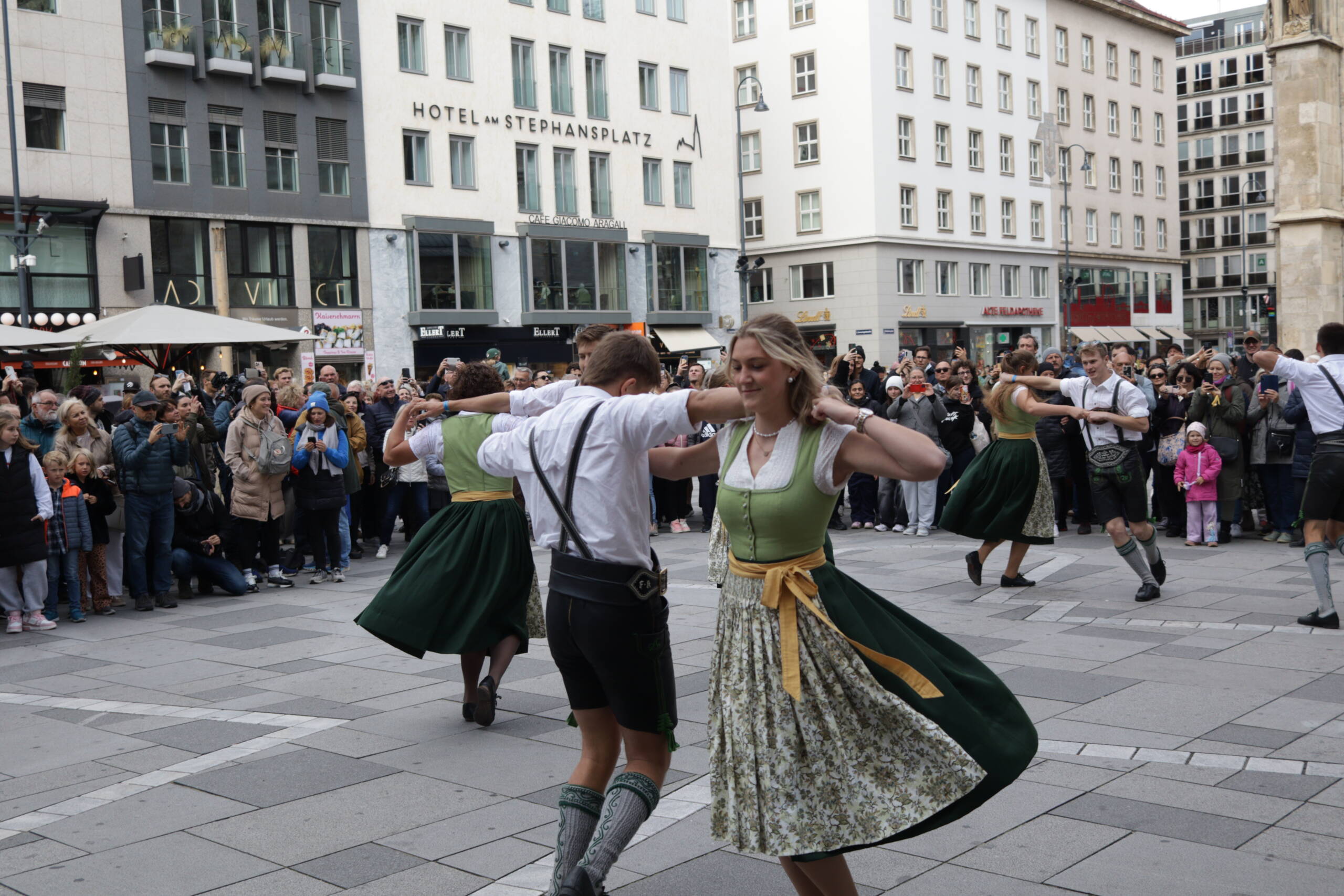
The man opposite her mirrors that discipline. White shirt, dark lederhosen, suspenders pulled taut across his back, and knee-high socks with traditional patterns—every detail feels intentional, almost coded. His posture is slightly forward, focused, like he’s guiding the rhythm without breaking the symmetry. You can almost hear the music even though it’s not visible, just inferred from the timing of their steps and the synchronized turns of the other couples scattered across the square.
And then there’s the crowd. A ring of onlookers, phones raised, faces lit with that mix of curiosity and delight. Tourists, locals, families—some bundled in jackets, others leaning in for a better angle. A little girl in pink stands near the edge, completely still compared to the dancers, watching something that probably feels both familiar and magical at the same time. The audience isn’t passive; it’s part of the scene, framing the performance, validating it, maybe even rediscovering it.
What makes this moment interesting isn’t just the dance—it’s the setting. Behind them, modern storefronts, clean facades, signage in crisp typography. “Hotel am Stephansplatz” sits there like a quiet reminder that this is a living city, not a museum. And yet, right in front of it, something older, slower, and more rooted unfolds. It’s not nostalgic in a forced way. It feels… continuous. Like the past didn’t disappear, it just learned how to exist alongside glass windows and smartphone cameras.
There’s a subtle tension in that, if you look long enough. Tradition here isn’t static—it’s being performed for an audience that includes people who don’t share it, who might see it as spectacle rather than inheritance. But the dancers don’t seem to adjust for that. They’re not simplifying it, not exaggerating it. They just dance. And that might be the most telling part.
Because European identity, especially in places like Vienna, doesn’t always announce itself loudly. Sometimes it shows up like this—structured, rhythmic, dressed in green and white, turning in circles that have been traced countless times before. Not trying to prove anything, just continuing.
Leave a Reply