A terrace above a sprawling city becomes less a place and more a stage suspended between air and light, the kind of scene that already feels halfway translated into paint before you even try. Two men sit at a small, almost delicate wooden table, their posture steady but not stiff, as if they’ve settled into the rhythm of speaking into the night rather than performing for it. The glow from the softbox lights wraps around them in thick, almost buttery strokes—light that doesn’t just illuminate but shapes them, carving their silhouettes against the vast, shimmering backdrop below. You can almost imagine a painter dragging a loaded brush across the canvas to capture that contrast: the controlled, warm foreground against the restless scatter of city lights stretching endlessly into the distance.
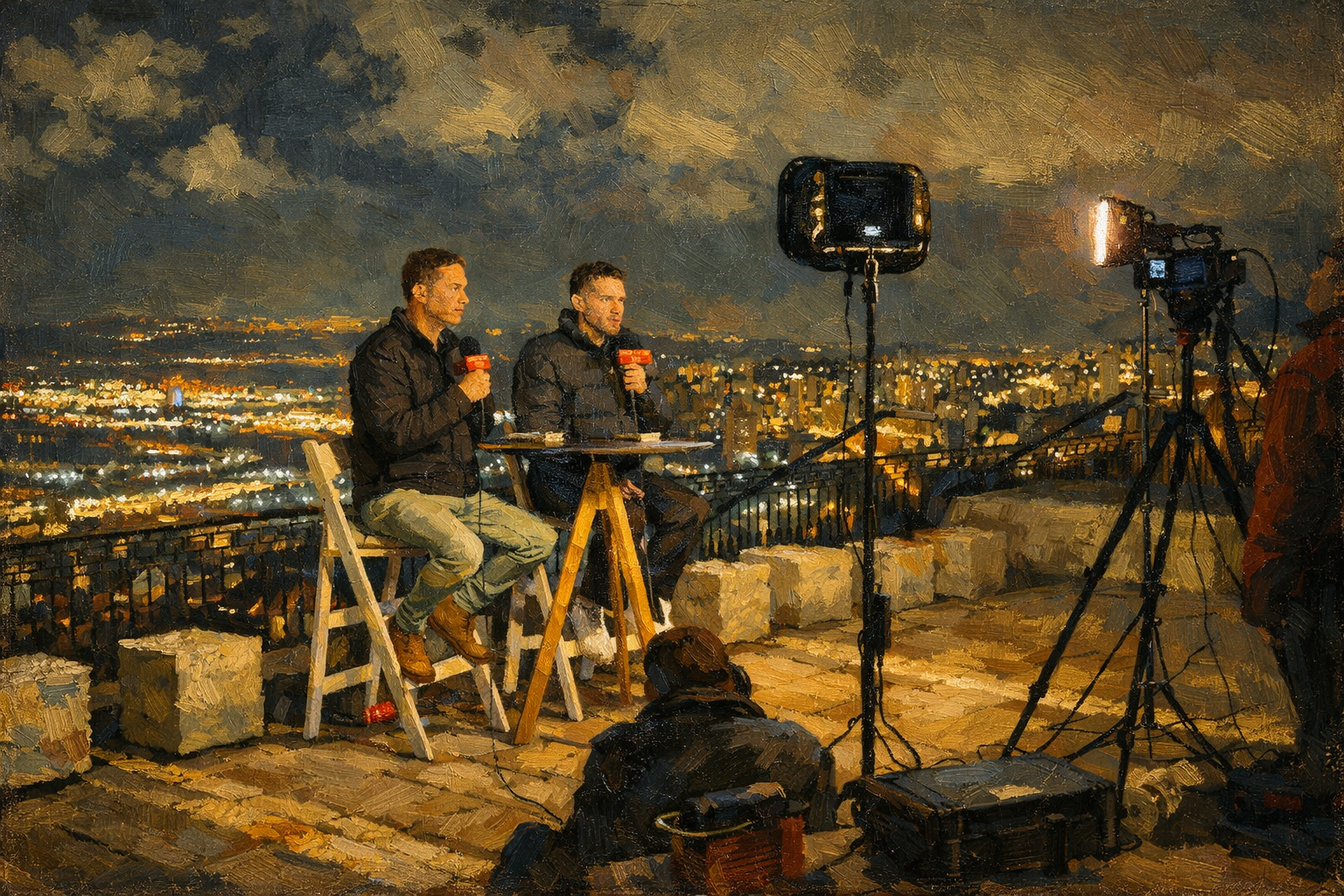
The skyline behind them is not sharp; it dissolves. Thousands of points of light blur into something impressionistic, like a field of color more than a collection of buildings. The sky above hangs heavy with layered clouds, textured and uneven, catching faint ambient glow—dark blues and greys blending into one another in slow, moody gradients. It’s the kind of sky a painter would exaggerate just slightly, deepening the shadows, pushing the highlights, letting it breathe as its own character rather than just a backdrop.
Then there’s the equipment, which in a photograph reads as technical but in a painting becomes almost sculptural. The light panels, the camera on its tripod, the cables loosely tracing lines across the stone floor—they introduce a geometry that contrasts with the organic chaos of the city beyond. A painter might simplify them into bold shapes: rectangles of light, angular silhouettes, a few decisive lines suggesting structure and intent. Even the crouched figure in the foreground, partially hidden, feels like a deliberate compositional anchor—dark, grounded, almost like a brushstroke meant to pull your eye back into the scene after it wanders too far into the glowing horizon.
The stone terrace itself adds weight, literally and visually. Its textured surface, those worn blocks and edges, holds the scene in place. It’s tactile, something you could render with dry brush techniques, rough and imperfect, anchoring the otherwise luminous atmosphere. The chairs, slightly mismatched, and the casual placement of objects—like the small cup on the ground—introduce a kind of lived-in imperfection. Nothing here is overly staged, and that’s exactly what gives it its painterly honesty.
What makes the whole image lean toward painting rather than pure photography is the tension between intention and accident. The lighting is clearly controlled, but the city is not. The conversation is deliberate, but the night is indifferent. A painter would lean into that—softening edges where needed, sharpening where emotion demands it, maybe even muting the equipment slightly to let the human presence and the vastness behind them carry more weight.
It ends up feeling like a modern nocturne. Not quiet, not serene, but layered—human voices framed against something much larger, captured in a moment that feels both staged and fleeting. And if you squint just a bit, you can almost see the brush marks already there.
Leave a Reply