You hear it before you understand it. A flat metallic tap somewhere off the nave, then a pause, then another, in a building where the loudest thing is usually a door closing. Nobody looks up. The regulars know what it is.
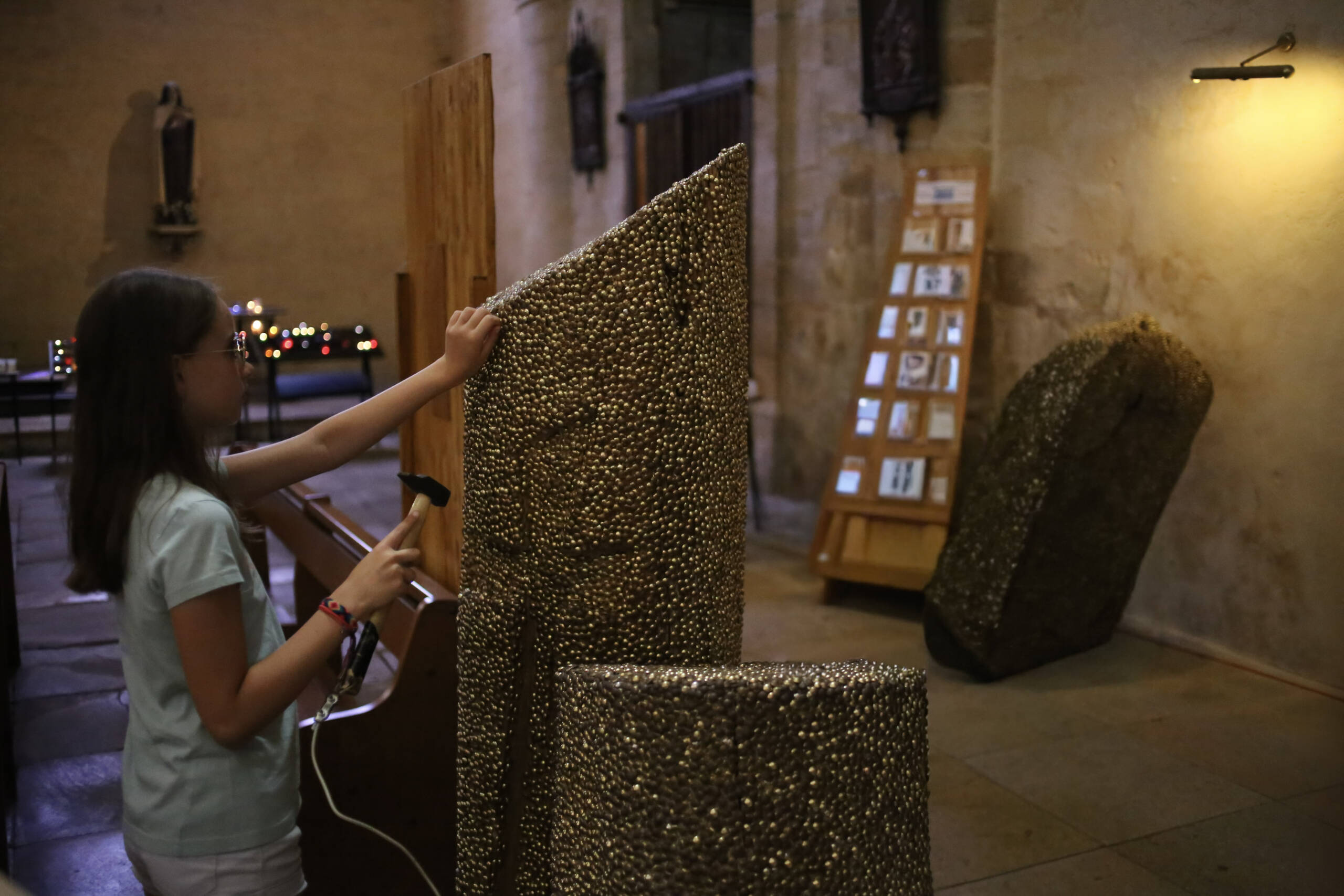
In a side aisle there is a section of tree trunk standing on end, chest high, and its entire surface has disappeared under brass nail heads. From ten metres away it reads as beaten gold, something dragged out of a treasury. Up close it is hardware. Thousands of domed heads packed so tightly that the wood underneath only shows through in a few thin seams, and even those are closing.
Next to it sits a basket of nails and a mallet on a cord. You take one, you push a coin or a note into the slot, and you drive the nail in wherever there is room. That is the whole transaction.
A parish priest’s idea, not a medieval one
The instinct is to date this to the Middle Ages. It is about fifteen years old.
The idea belongs to abbé Philippe Demoures, who ran the Sarlat parish from 2010 to 2019 before moving to the Bergerac area. He had seen trunks like it as a child at Brantôme, where they collected for Secours Catholique, and again at the Porte Saint-Joseph in Lourdes. He brought the format back. By the end of the decade something like fifty thousand nails had gone into six different trunks across the local churches, paying for building maintenance and a few parish projects along the way.
Nobody got rich. The sums were useful, which in a rural French parish with a listed roof is the only measure that matters.
Why it beats a collection box
A collection box asks you for money and gives you nothing back except the sound of the coin landing. The trunk inverts that. It asks you to do something, and takes the money almost incidentally, on the way past.
Demoures put it plainly when asked why it worked: people want to leave a trace. Some do it with a candle, some by writing a line in the book of intentions. This is the same impulse with a mallet attached, and it lands equally well on visitors who would never light a candle. There is no belief required at the door. A ten-year-old on holiday will queue for it because you get to hit something in a church and nobody stops you.
The object also grows, which the collection box does not. Every nail you can see is somebody else’s small decision. That is not a metaphor the parish had to explain on a laminated card. It is just what the thing looks like once a few thousand people have been through.
What you actually find in the churches
Saint-Sacerdos in Sarlat is the obvious place to look, and the one most visitors encounter first, but the trunks spread across the smaller churches of the Périgord Noir and they are not uniform. Some are the original round sections. Others are flat slabs, or squat columns, or offcuts propped against a wall.
The variety is worth paying attention to, because it tells you where a church is in the cycle. A piece with bare wood still showing is new. A piece that is solid gold on every face, with the nails starting to crowd sideways and overlap, is finished, and it usually stands retired against the wall while a fresh plank waits nearby. In a church that has been running this for a decade you can find three generations of them in the same bay.
The lighting rarely helps. These things sit in side aisles under whatever bulb was already there, next to a rack of electric votive candles glowing red and blue on their little timers, which is its own comment on how French parishes have adapted. If you want a photograph, come in the afternoon when the aisle windows are doing the work, and get close enough that the surface reads as texture instead of a gold rectangle.
Bring coins. The slot does not take cards, and it never will.