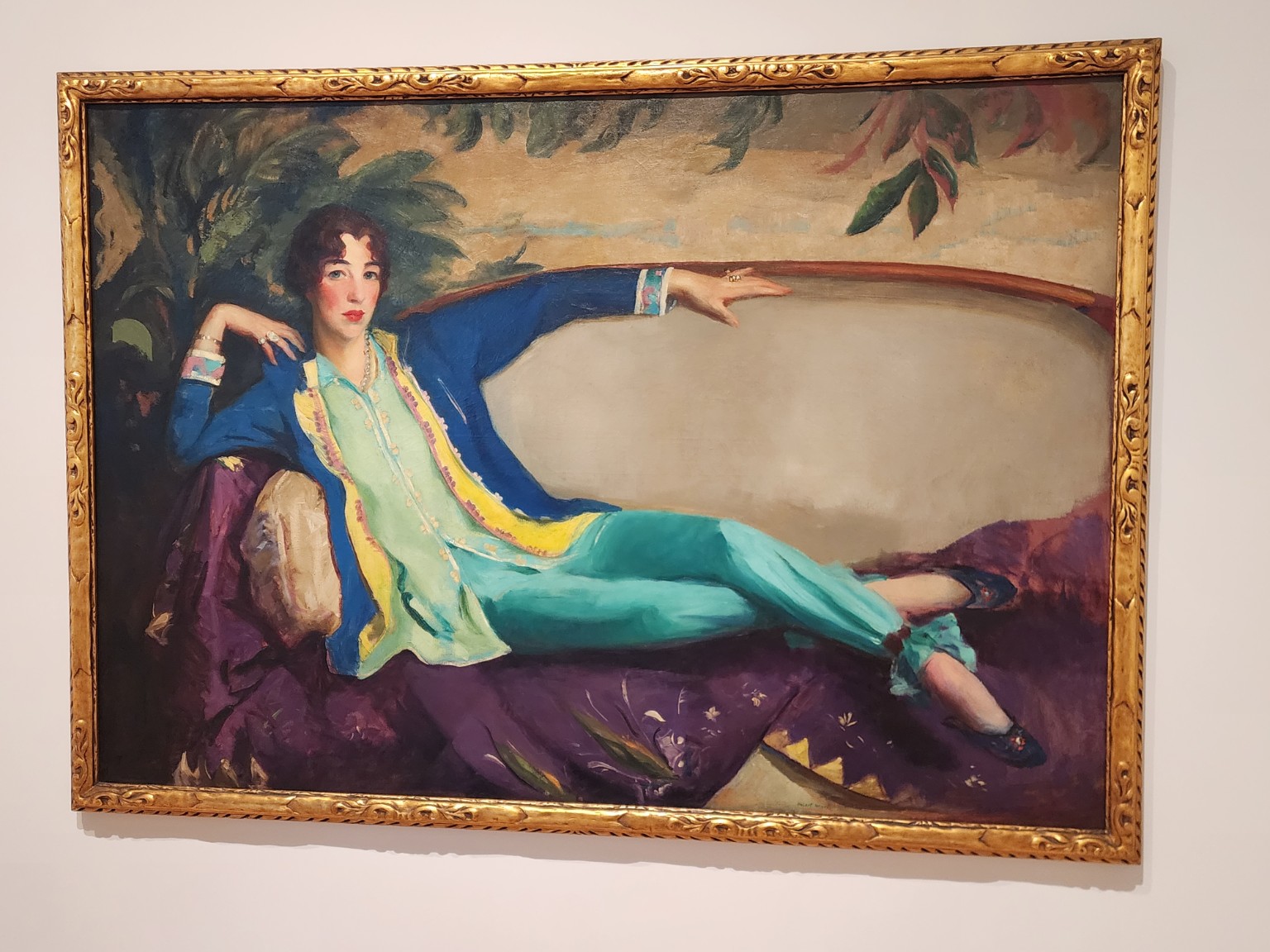
In 1916, American painter Robert Henri created a portrait of Gertrude Vanderbilt Whitney that would become an enduring image of artistic independence. The subject reclines across a sofa in a blue jacket, green tunic and turquoise trousers, surrounded by richly colored textiles. Behind the informal pose lies a story of wealth, rebellion and the changing place of women in American society.
Born into the Vanderbilt family in 1875, Gertrude married Harry Payne Whitney in 1896. She might have confined herself to the social obligations of New York high society, but instead became a serious sculptor and a champion of living American artists. Henri, associated with the Ashcan School, was an apt choice to portray someone who wanted to be understood as an individual rather than simply as an heiress.
The composition is extraordinary in its confidence. Whitney stretches almost the full width of the canvas, one arm resting near her shoulder and the other extended along the sofa. Purple upholstery, a pale background and foliage frame her vividly colored clothing. She meets the viewer’s gaze without the expected formality of a society portrait. The painting’s loose handling and bold color emphasize character over ceremonial status.
Her trousers were especially provocative in 1916. Western fashion was beginning to experiment with flowing tunics and garments influenced by Asian and Middle Eastern dress, but trousers remained socially controversial for women in many contexts. Whitney’s husband reportedly objected to hanging the portrait in their Fifth Avenue home because of the way she was dressed. Instead, it was displayed in her Greenwich Village studio.
That studio was much more than a refuge. Whitney worked as a sculptor and supported artists who lacked recognition from established institutions. Her studio initiatives helped lead to the Whitney Studio Club and Whitney Studio Galleries. After the Metropolitan Museum of Art declined her proposed gift of American art and funding, she founded the Whitney Museum of American Art in 1930; it opened in 1931.
There is an irony in the painting’s history. An image deemed unsuitable for a fashionable private mansion became an emblem of a major public museum. Whitney’s wealth gave her unusual freedom to defy expectations, and not every woman of her era had those opportunities. Yet she used that position to build lasting support for artists and a different conception of American cultural importance.
Henri’s portrait also transforms an old artistic convention. Reclining women had appeared for centuries as mythological or idealized figures, but this sitter is a recognizable modern woman, fully aware of her own presence. The painting does not ask us to admire an abstract ideal of beauty. It asks us to encounter a person with ambitions, preferences and authority.
Created four years before the Nineteenth Amendment prohibited denying voting rights on the basis of sex, the portrait captures a society negotiating new roles for women. Its cultural significance lies not merely in an unusual costume, but in the confident presentation of a woman determined to be an artist and patron in her own right. What once unsettled her household now helps tell the history of American modern art.