The photograph shows a crowded gallery interior, with visitors gathered in front of a wall displaying a varied collection of modern and contemporary paintings. The wall text at the top identifies the space as “The John Hay and Betsy Whitney Gallery,” so this is clearly a museum-gallery setting rather than an ordinary commercial gallery.
Several works stand out. At upper right is a large, strongly geometric abstract painting dominated by angular shapes in blue, orange, yellow, black and muted red. Immediately to its left is a smaller, busy composition of fragmented reddish, gray and black forms. Near the center is a colorful still-life or abstract composition with red, green, yellow and blue shapes, while the oval painting below and to the left has a much more figurative, layered appearance. On the far right, visitors partially obscure a large painting featuring what appears to be a horse or animal head, with a pale face and prominent eye.
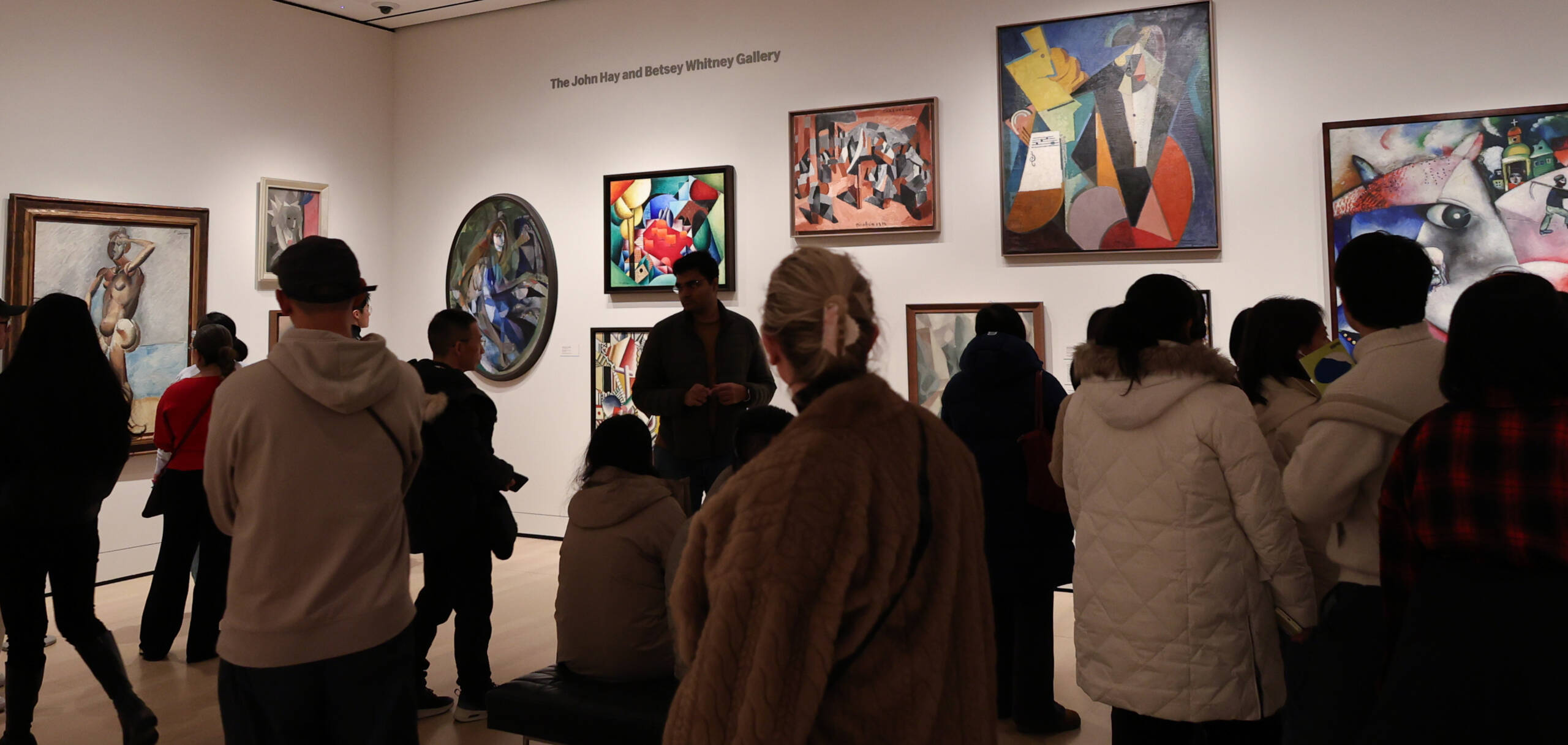
The visitors themselves give the photograph its documentary character. Rather than photographing the artworks in isolation, the image captures people actually engaging with the exhibition: some are standing close to the paintings, several appear to be listening to or watching a person near the center, and others are moving through the gallery. The lighting is relatively subdued, which makes the illuminated paintings stand out against the darker silhouettes of the visitors.
- Soviet Constructivist Posters and the Birth of the Modern Ad Layout
- Night Street Poster Turns Shop Light Into Amber and Indigo
- Neon Reflections: Turning Poolside Light Into Abstract Poster Art
- Finding the Poster You Half Remember in a Collection of Thousands
- How the Triptych Outlived the Altarpiece, From Bosch to Bacon to the Documentary Frame
- Jules Verne Meets Leonardo on the Loire: The Art Behind Nantes' Machines
- Promenading Couples After Dark: What Night Street Photography Inherited from Caillebotte and the Gaslight Painters
- Why 1960s Saint-Tropez Black and White Photos Are So Addictive
- Morning Class: A Photograph That Works Like a Frieze
- MoMA's Cubist Salon: Why the Museum Crowded a Wall It Spent Decades Emptying