France has a way of turning a handsome city square into a stage for political confrontation. There is the architecture, impeccably composed; there are the trees, clipped into neat green crowns; and then there are the helmets, shields and banners, making their own arrangement across the street. Frenchmen, ever rioting? The phrase comes easily when looking at a scene like this, although the photograph itself shows a tense encounter between police and demonstrators, not proof of a riot. That distinction matters, even when the spectacle feels thoroughly familiar.
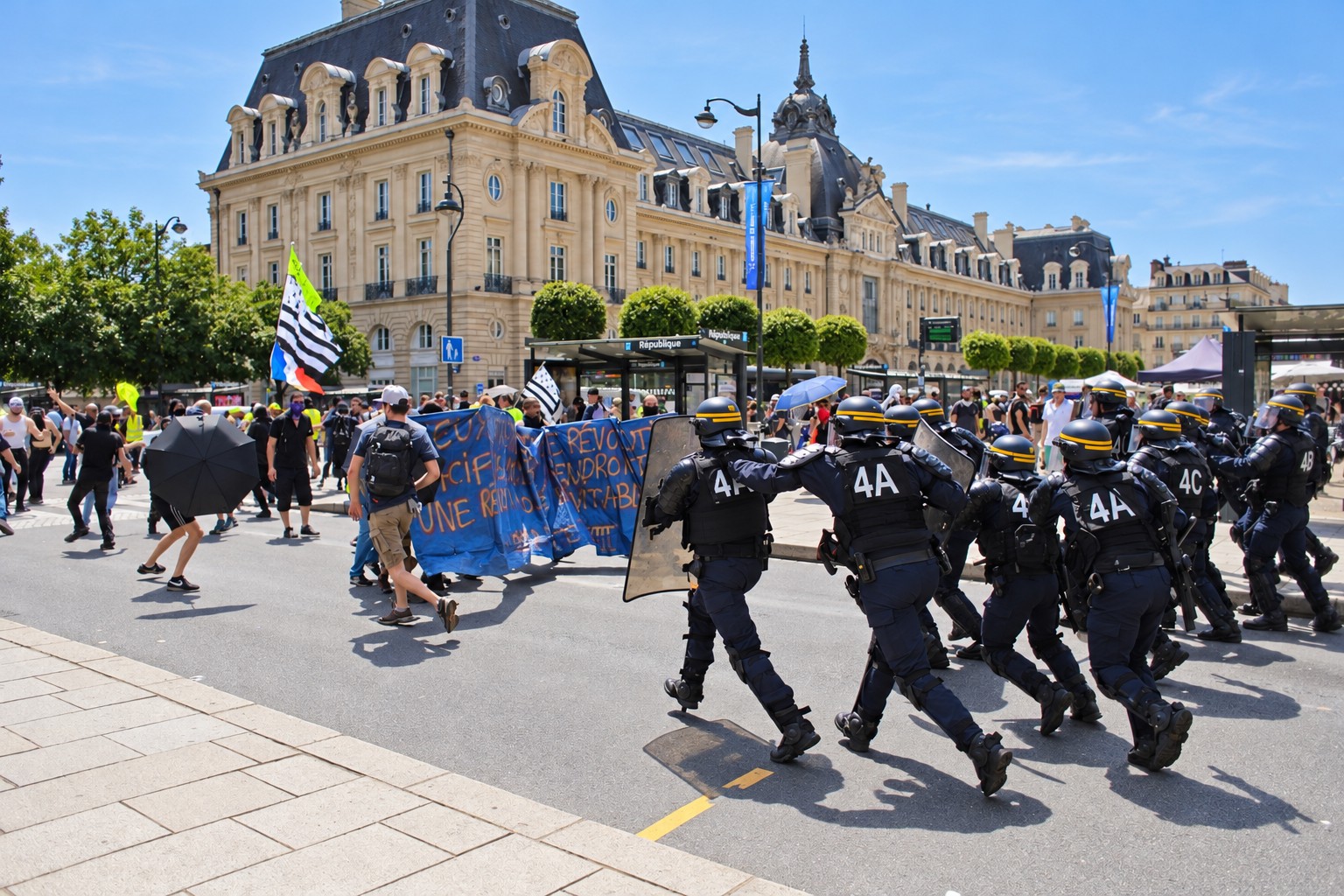
The photograph is full of movement. Across the right-hand foreground, officers in dark protective uniforms advance together, their bent knees, heavy boots and overlapping shields giving the formation a compact, almost mechanical rhythm. Yellow bands circle their helmets, while large white unit markings stand out against their backs. Facing them, demonstrators hold a makeshift line of blue banners covered with orange lettering. A black umbrella opens like a dark geometric flower on the left; above it, a black-and-white Breton flag catches the light, with bright green fabric fluttering higher still. Behind the crowd, the République transport shelter sits beneath a long cream-colored building with tall windows, wrought-iron balconies, sculpted dormers and a steep slate roof. Strong sunshine throws hard shadows over the asphalt. It could be a postcard, almost, if the foreground belonged to a different afternoon.
What makes the scene compelling is the collision between civic elegance and civic anger. The square has all the furniture of ordinary urban life: public transport, street lamps, trees, passing pedestrians. Yet the street has become a place where authority is physically asserted and challenged. The uniforms suggest preparation for disorder; the banners announce a refusal to disappear quietly. A still image cannot tell us what preceded this moment, what the demonstrators demanded or how the encounter ended. It does show how quickly familiar public space can acquire another purpose, and how small the distance can be between going about the day and becoming part of a confrontation.
France’s tradition of taking political arguments into the street can be admired as democratic stubbornness and criticized as an exhausting habit. Both reactions are understandable. Peaceful protest deserves protection; violence against people and the destruction of shared streets deserve scrutiny, whoever is responsible. The trouble begins when those distinctions disappear into a single theatrical image of national temperament. Here, the most revealing detail may be the building behind everyone: serene, elaborate, apparently indifferent. Down below, the argument continues. The city looks ready to outlast it, though the people crossing that hot pavement have rather more immediate concerns.