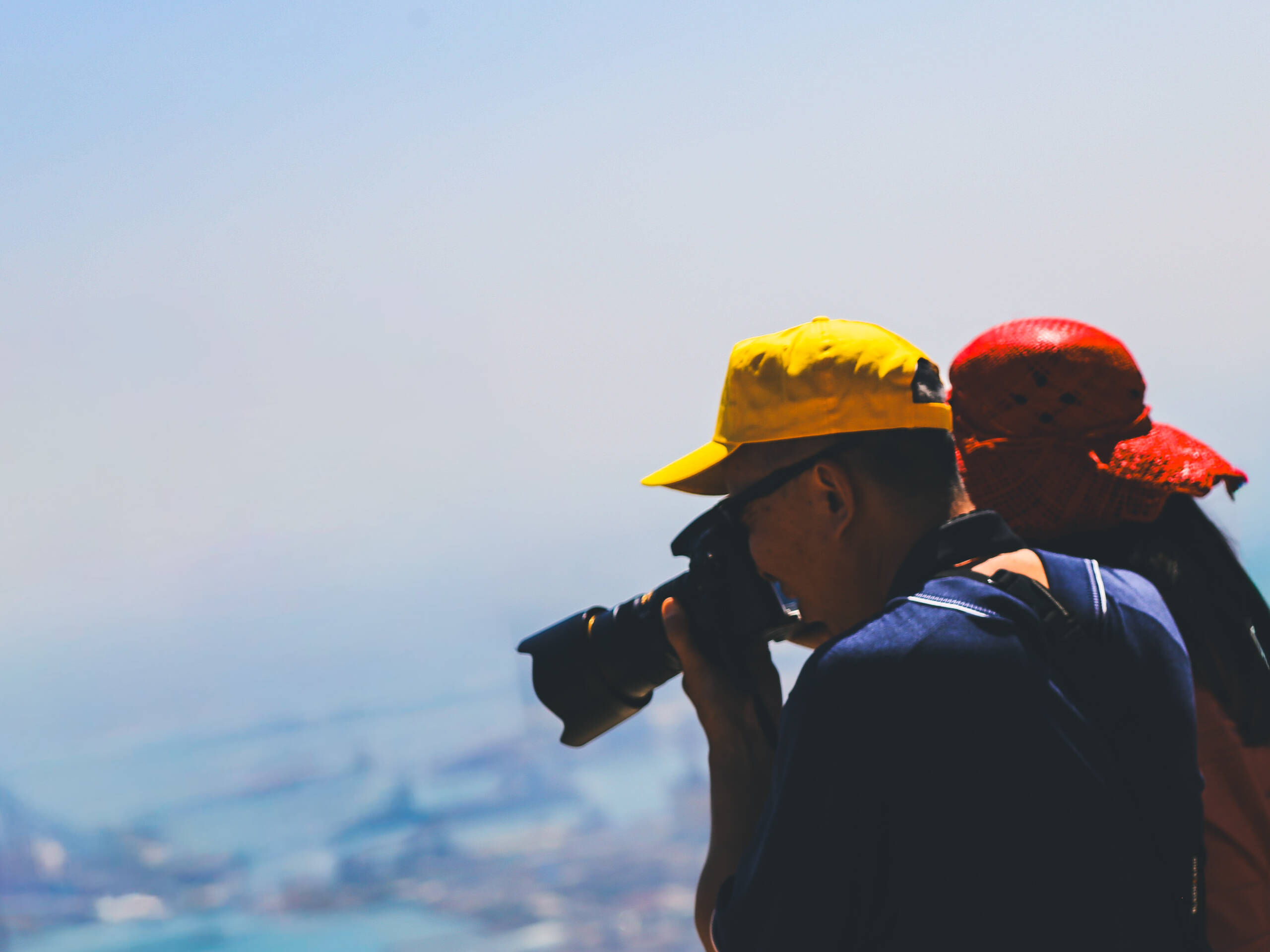
He raises the camera to his eye, yellow cap bright against the pale sky, and for a moment the whole wide view is reduced to whatever fits inside the lens.
Behind him, another figure in a red headscarf shares the same overlook, both of them turned toward the hazy stretch of land and water far below. The air is soft, the horizon blurred, the kind of light that makes distance feel endless.
There is a quiet ritual in these moments. Climb high enough, find the edge, and then try to hold a piece of it. The camera becomes less a tool and more a way of saying: this mattered enough to stop for. This was worth framing.
From up here the world looks simplified — shapes, colors, the slow curve of the coast. Down there life continues in its usual detail. Up here, for a few seconds, someone chooses what to keep.
- Nikon Z5 IIC Review for Content Creators: Full-Frame Video for $1,400, No Viewfinder
- Canon EOS R8 Mark II vs EOS R8: IBIS and a Joystick for $400 More
- Vintage Lenses on APS-C and Micro Four Thirds: Crop Factor, Flange Distance and Speed Booster Tables
- Can a Website With Only Original Photos Rank on Google Without Text?
- OpenAI Buys Glass Imaging for Over $300M, Triple Its 2025 Valuation
- Why Sony Camera Menus Are So Confusing, Even After the 2020 Redesign
- Wedding Photography: The Best Frames Happen Between the Poses
- Golden Hour on the Promenade: Five Walkers, One Unplanned Frieze
- 55th World Used Camera Fair Runs Through September 9 at Matsuya Ginza
- Why a Fisheye Is the Natural Lens for Cathedral Interiors