Four dancers in blue robes with red lining and red underskirts move barefoot across a lit wooden stage, with a carved stone relief panel behind them. The dance is Okinawan, from the Ryukyuan tradition, and the tungsten stage light is warm. At the bottom of the frame an audience member’s hand is raised, holding a phone, and its screen shows the same four dancers again, smaller and brighter.
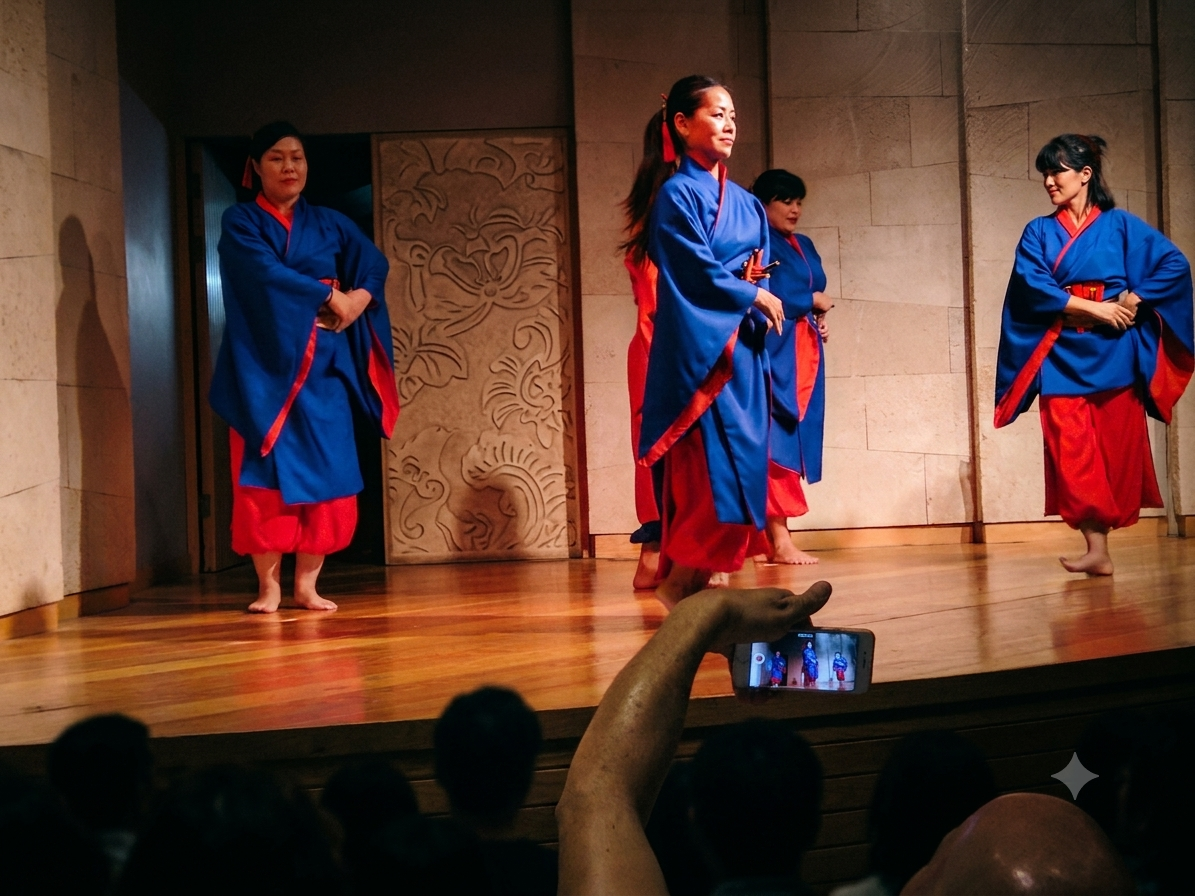
Two Audiences in One Room
Anyone who’s been to a concert, a play or a festival in the past decade knows this view. The stage is there, and between you and it sits a field of screens. Some people in the room are watching the dance. Others are watching a recording of it, live, at arm’s length.
The phones change what the performers see as well. From a lit stage the auditorium is mostly dark, and a scatter of glowing rectangles is the brightest thing out there. Every raised screen is a small light pointed back at the dancers.
Performers split on this. A number of comedians and musicians now lock phones in sealed pouches at the door so the audience has to look up. Heritage performance has a different problem. A dance tradition with a small pool of trained performers needs people to know it still exists, and a clip on someone’s feed does more for that than a printed programme ever did.
Ryukyuan classical dance grew up at the court of the old Ryukyu Kingdom, where music and dance were staged for envoys arriving from China. Kumiodori, the related court music-drama, has been on UNESCO’s list of intangible cultural heritage since 2010. What’s kept these forms going is teachers, schools, families who send their children to lessons, and audiences who turn up.
What the Phone Actually Keeps
The recording in that raised hand will probably be watched once, maybe twice. It’ll be shaky, the sound will be thin and the dancers will be tiny. As a record of the dance it’s poor. As a record of having been in the room it’s exactly right, which is why people keep doing it.
The photographer a few rows back caught the stage and the person standing between it and everyone else. That’s what a live performance looks like now.